

"The Airport Model™" Article #5: The Aircraft (20% Influence) – The Execution Platform: A System That is a Tool, Not a Religion

Updated: Jan 10
Introduction: Don't Attempt to Cross the Ocean with a Helicopter
In the world of aviation, no company would attempt to fly 400 passengers from Tel Aviv to New York using a helicopter, nor would any pilot attempt to land a Boeing 747 on a rooftop. This is not a matter of belief or religion; it is a matter of functional fit. The aircraft is the tool that defines the boundaries of capability: speed, flight range, and payload capacity.
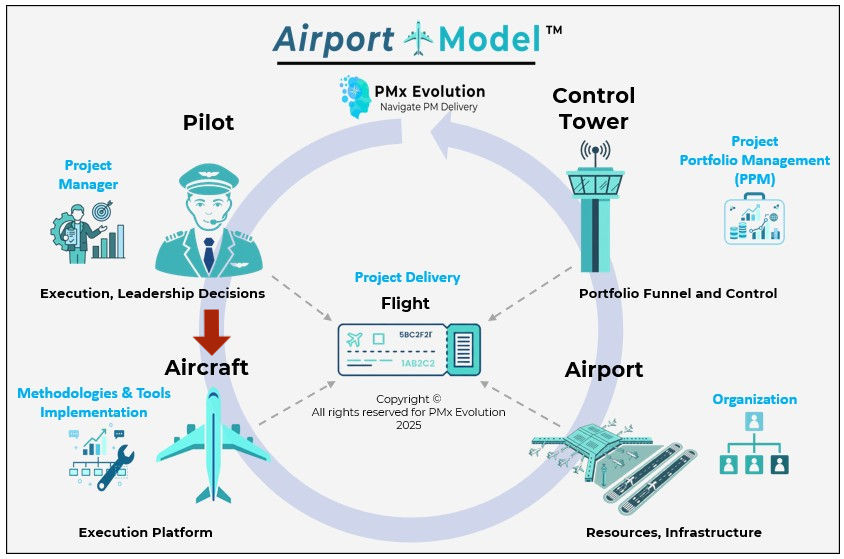
In the first article of "The Airport Model™" series, we introduced the four critical factors for project delivery. After diving deep into the role of The Pilot (10%), it is time to discuss their vehicle: The Execution Platform (The Aircraft) – the component that accounts for 20% of a project's success.
Many mistakenly believe that a talented project manager can "overcome" any toolset. The reality is that even the world's best pilot cannot fly a craft that wasn't designed for the mission, or one with a broken instrument panel.
The Execution Platform (The Aircraft) represents a 20% impact factor. Unlike the pilot, who is a human decision-maker, the platform consists of the process applications and tools that dictate the organization's capacity limits. An aircraft that is poorly designed, incorrectly selected, or inadequately maintained cannot fly far or consistently.
1. The Aircraft: A System of Tools, Not a Religion
A common organizational error is treating a methodology (such as Agile or Waterfall) as a "religion" or a rigid ideology. The aircraft is a tool. It is a means for creating consistent delivery and must be selected and adapted based on the payload (Scope), the destination (Value), and flight conditions (Complexity and Uncertainty).
Clarifying Aircraft Replication: The Failure of Local Implementation
It is vital to remember: The Execution Platform is not just the theoretical methodology; it is its actual implementation. If an organization manages five projects, there are effectively five different execution platforms—five different levels of implementation and maturity of the same methodology. Delivery failure often stems from flaws in local implementation, which is why we emphasize application as the factor driving this 20% impact.
The Execution Platform consists of three core elements:
The Airframe and Engine (Methodology): How the project is planned, managed, and executed (Agile, Scrum, Waterfall, Hybrid).
The Instrument Panel (Management Tools): The technological stack (Jira, Asana, Monday) used for reporting, transparency, and task management.
Flight Procedures (Work Rituals): The daily DNA—status meetings, testing processes, and team synchronization.
2. Two Critical Failures in the Aircraft System
These failures are the most common causes of inconsistency in project delivery and undermine the pilot's ability to maintain control:
A. Misalignment Failure: Using an Unsuitable Execution Platform
Many organizations adopt a single methodology "because everyone else is doing it," forcing their pilots to use it even when it is impractical:
Complexity Fit: Projects with a well-defined scope and low technological risk (Waterfall) will suffer from delays and unnecessary overhead if forced into a hyper-fast methodology (Agile).
Environmental Fit: Attempting to operate a "wide-body aircraft" (Scale-Agile) when only small, isolated teams are involved leads to a massive waste of effort on redundant meetings and reporting.
The Solution: The organization (The Airport) must define a methodology selection process based on project classification (complexity, uncertainty, value) rather than trends or coercion.
B. Maintenance Failure: Cheap Spare Parts and a Broken Dashboard
Even if the execution platform is sound (a solid airframe), the aircraft's primary maintenance lies in its tools and rituals:
Disconnected Management Tools: If the management dashboard is not connected to the actual reality on the ground, the pilot is flying "blind," and leadership makes decisions based on fantasy.
Broken Work Rituals: When meetings become "bureaucratic events" rather than decision-making tools, they turn into engine noise that disrupts focus. The result: The project manager spends their time on manual data collection ("manual firefighting") instead of informed decision-making.
The Solution: Automation and Data Validation. Implement "data cleaning" routines and build integrations between development tools and management platforms so the dashboard reflects real-time data without biased human intervention. Tools must serve the pilot, not burden them.
The Airport’s (Organization) Responsibility for Maintenance
The pilot operates the aircraft, but the organization (The Airport) is responsible for its maintenance and upgrades. This responsibility is critical to ensuring delivery consistency and includes:
Condition Monitoring: Processes to ensure the methodology actually works and provides the necessary data for portfolio management (before and during use).
Training and Upgrades: Investing in ongoing training for pilots and crews (development teams) on tools and methodologies—ensuring they know how to correctly utilize new technologies.
User Alignment (Adoption): Addressing misalignments or resistance. Without close support and feedback loops, investment in tool implementation can go to waste. If the organization fails to invest in the maintenance of the execution platform, the aircraft becomes obsolete, performance drops, and eventually, the flight becomes dangerous.
3. Summary: The Aircraft Awaits Takeoff Clearance
To build resilient and profitable delivery, you must stop treating methodologies and tools as "mandates from above." Treat your Execution Platform as a strategic asset that requires constant maintenance. A well-maintained aircraft allows the pilot to focus on what truly matters: bringing the project to its destination safely and on time.
Next Step: Navigating Organizational Weathe
In the next article in this series, we will analyze the role of The Airport (The Organization - 30% Impact). We will examine how organizational culture, matrix structures, and resource availability form the "ecosystem" in which your aircraft operate—and how it can serve as either a powerful tailwind or a disruptive storm.

Copyright © 2023 - Present PMx Evolution. All rights reserved.


